So, let’s consider the context we’re in right now regarding retaining and developing out teams. I believe we’re entering a decade where we are and have started talking a lot more about skills and than jobs, and that skills are going to become the new currency of ‘Work’.
Your employees, and even you dear reader, are going be talking about the skills that you have, not talking about, necessarily, what you’ve done and as a part of this skills with be topics of discussion your manager, colleagues, and leadership.
In this decade, I also think we’re also going be talking a lot about how AI is accelerating change, but the disruption here is not the technology per se. It’s the visibility and speed in which it’s changing things.
To move forward from within your own context it is helpful to ask: How can AI help us at scale?
If you haven’t picked up my bias yet, here it is: I think skills are important! And I am bold enough think that you’re with me on this. But there is a challenge. To be honest, there is always a challenge or 14 of them, and that challenge is is how do we operationalize them?
My experience to try and operationalize skills started with an Excel file and team leaders were also in the same Excel file and changing things. Arrgh! And we faced the common dilemma about what do we mean. Fore example, some said their team needs ‘communication’ skills and others said their team needed ‘communications’ skills. Who knows what they’re talking about, really?
Those that do want to work with skills are working are now focused on getting to a point they can go from ‘talking about skills’ to being able operationalizing them. This means we’re incorporating them into hiring, development pathways, and employee mobility.
So, I have three questions that have come to my mind lately:
- Does our team have skills they need right now?
- Can we deploy talent faster than recruit it?
- Are we developing people for roles that may not exist yet?
These questions are not quickly answered. They genuinely need a lot of time to answer. And we should also be honest here that they could bring a degree of pressure when you read them because you’ve asked yourself these questions or perhaps someone’s asked you these questions.
Even though there has been record investment in skills development, there is generally still a skills shortage that is persisting in most organizations, and we continue to be grappling with the question “Do we have the skills to meet the organizations needs both today and in the future?”
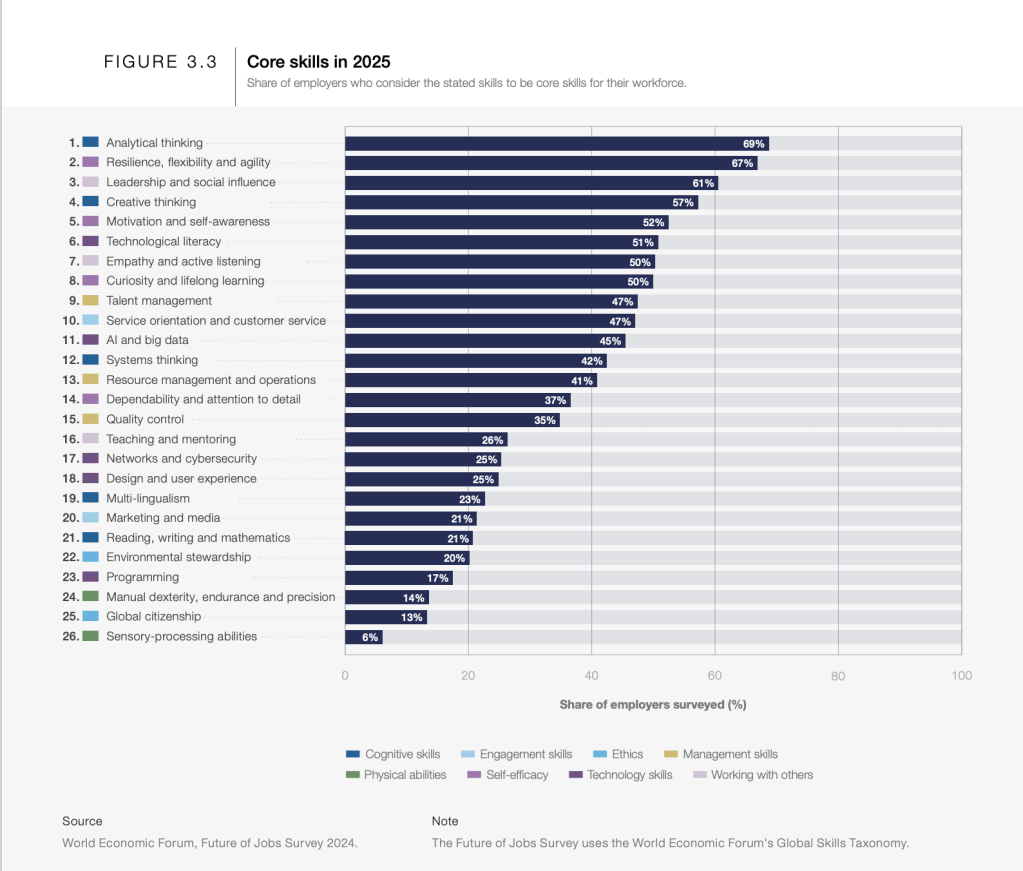
On top of this we’ve got the World Economic Forum report Future of Jobs Report 2025 reporting that by 2030 that nearly 40% of the skills our teams use today will be outdated.
Check out the top core skills of 2025 according the WEF:
A part of this shift, our employees are no longer planning careers, they’re thinking about “How I leverage my capabilities that I stay employable and valuable, and I can keep growing?”.
On this great skills shift, I have three ideas I would like to unpack with you in the next few blogs:
- Skills are the new operating system for talent
- The skills visibility gap is the biggest constraint on AI
- Employee expectations have shifted from ‘Careers’ to ‘Capabilities’
As Sarah Harrington, CPO at Skillsoft puts it:
“…as we look to the future, it’s clear that skills are becoming the new currency of work. Instead of asking ‘What is your job title?’, we’ll be asking ‘What skills do you bring, and how proficient are you in them?’”
 Andrew Mina
Leave a comment