
For years, HR has lived in the tension between two forces:
Care for people and Compliance with process and policies
That tension isn’t new. But right now it is being exposed live never before.
We all carry our own stories of HR.
If we’re honest, HR can feel like a paradox: part midwife, part funeral director.
They welcome you into the organisation… “We have a new colleague, please welcome [First_Name]!” and, at times, they’re there when you leave… “We have ceased cooperation with [First_Name], please reach to [Manager_First_Name] for any questions”.
(No shade on Midwives or Funeral Directors – both are deeply human roles.)
To be honest you meet HR on some of the best days of your career and sometimes, on the hardest.
Has HR lost its heart?
So it’s fair to ask: Has HR lost its heart?
I don’t think so. But I do think something else has happened.
The challenge isn’t that HR became less human. It’s that modern organisations have asked HR to operationalize humanity.
- To standardise the workplace experience.
- To systemise fairness through DEI.
- To scale empathy through policy.
And in doing so, something subtle happens:
The work becomes visible.
The heart becomes invisible.
The verdict is in on HR’s heart!
Because HR is often judged by its outputs: More effective policies, strategic procedures, and faster decisions.
But those are just artefacts.
The real work of HR happens in moments:
- A conversation handled with care.
- A difficult message delivered with dignity.
- A pause taken when it would be easier to rush.
Those moments don’t live in documents or the intranet or the shared drive. They live in people!
HR has always had a heart!
That’s why I still firmly believe that HR has always had a heart. Not because of what HR does but because of who HR is. Most HR professionals didn’t choose this career to enforce policy or spend their days in spreadsheets.
They chose it for people.
- For care.
- For growth.
- For the chance to help someone navigate their work—and maybe even their life—a little better.
And yet… even the most people-centered professionals can lose heart at one time or another.
Policies collide.
Pressures build.
Decisions have to be made that don’t always feel good yet necessary.
I’ve felt that personally throughout my career: when my paternity leave wasn’t approved, when leave was denied, and I was released from my role.
Moments like these felt cold. Final. Clinical. What I know looking back that it wasn’t a lack of heart. It was a system doing exactly what it was designed to do.
Research shows that while 92% of CEOs see HR as empathetic, only a fraction of employees experience that same empathy in their workplace.
Which raises an uncomfortable truth:
The heart of HR may still be strong but the system around it doesn’t always let it show.
And that’s the tension:
HR holds both humanity and system at the same time.
But when the heart gets buried for too long, the impact ripples. Gary Hamel and Michele Zanini write we are to:
“…build organizations that give every human being the opportunity to thrive.” (Humanocracy, p.6)
Because HR isn’t just another function. It shapes how people experience work itself and when HR loses heart, even temporarily, we all feel it.
The condition of the HR heart
This is where the current moment matters and it isn’t just because of the rise of AI and HR technology maturing nor it is it about efficiency. It’s about choice.
If AI and great HR technology takes 20–30% of the administrative load away, and we hope that it does, what fills the space?
More optimisation?
Or more humanity?
The next era of HR won’t be defined by what we automate but how we choose to re-humanise our workplaces.
Reconnecting the heart
So if you’re in HR, and something feels a little disconnected right now… Not broken. Not gone. Just harder to access. Here are five books I believe that can help you find your way back.

Atlas of the Heart: Mapping the meaningful connection and the language of human experience
Brene Brown (2021, Penguin Books)
Because you can’t support people well if you don’t have the language for what they’re feeling.
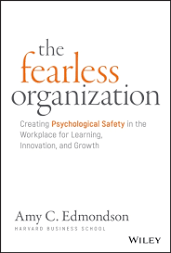
The Fearless Organization: Creating Psychological Safety in the Workplace for Learning, Innovation, and Growth
Amy C. Edmondson (2018, John Wiley & Sons)
A powerful reminder that psychological safety isn’t soft—it’s foundational.

Glad We Met: The art and science of 1:1 meetings
Steven G. Rogelberg (2024, Oxford University Press)
Reframing 1:1s as meaningful human connection, not just recurring meetings.

Head & Heart: The art of modern leadership
Kirstin Ferguson (2023, Berrett-Koehler Publishers)
A guide to leading with both clarity and care.

Humanocracy: Creating organizations as amazing as the people inside them
Gary Hamel and Michele Zanini (2020, Harvard University Press)
Challenging the bureaucracy that often distances us from the people we’re meant to serve.
These aren’t just books for HR. They’re for anyone shaping the employee experience.
Because HR doesn’t own “heart” in an organisation; they can only lead the way.
I got a pulse!
So no… I don’t believe HR has lost its heart. I believe it’s been there all along.
Quiet.
Resilient.
Sometimes hidden beneath the weight of how we’ve designed the work.
And now, we have an opportunity. Not to reinvent HR but a returning to it.
- More intentional
- More human
- More aligned with why so many stepped into this profession in the first place
The heart is still there.
The question is:
Will we design our work in a way that lets it be seen?
Question
What books would you add to this list?
I’d love to hear what’s helped you or your teams bring more heart back into HR.
Leave a Reply